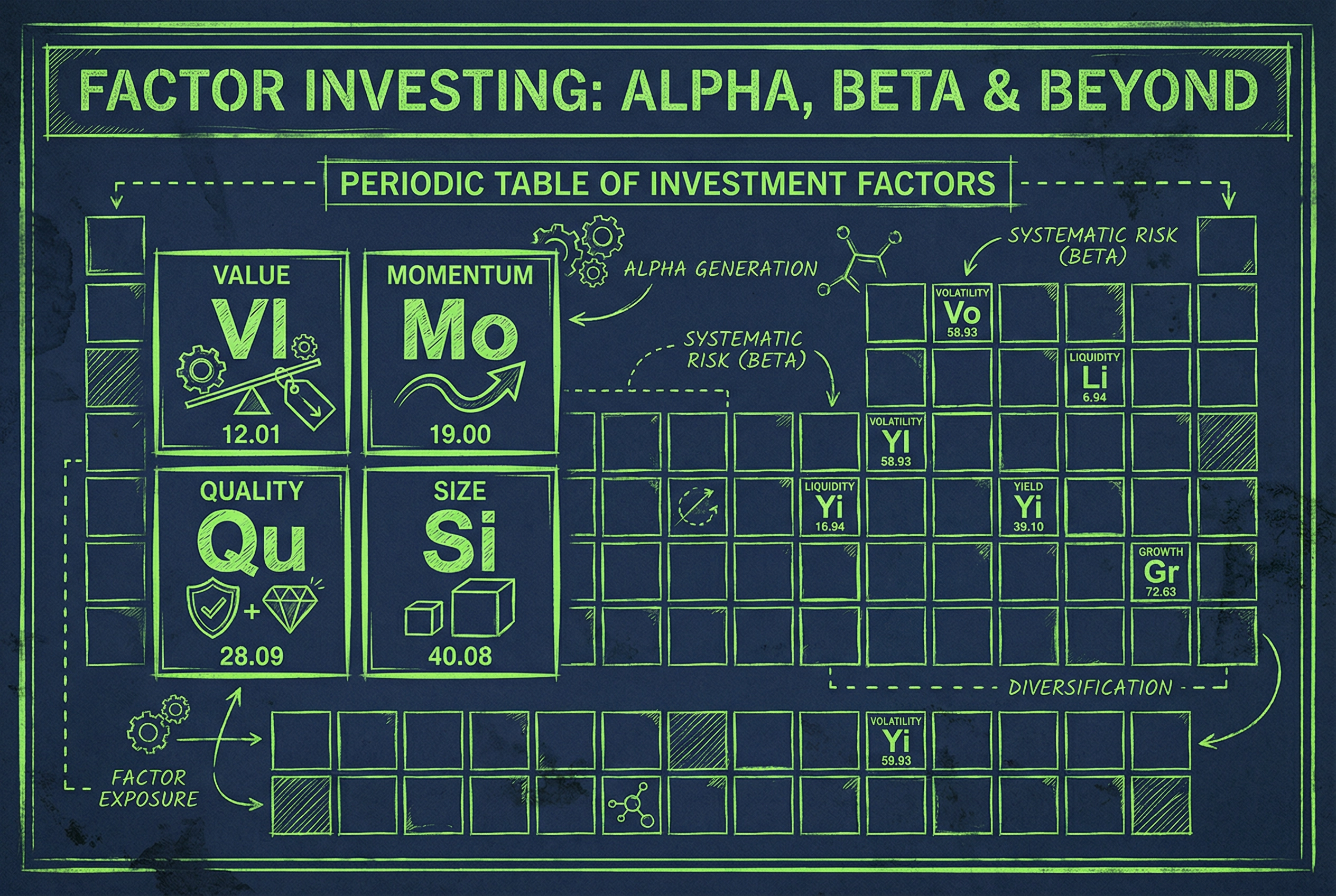
Factor Investing: Alpha, Beta and Beyond
The academic literature has documented over 400 "factors" — systematic return drivers that explain cross-sectional variation in asset returns. This proliferation has been called the "factor zoo," and navigating it requires both statistical rigor and economic intuition.
The Five Canonical Factors
The Fama-French five-factor model provides the foundation:
| Factor | Proxy | Economic Rationale |
|---|---|---|
| Market (MKT) | Market excess return | Compensation for systematic risk |
| Size (SMB) | Small minus Big | Small firms are riskier, less liquid |
| Value (HML) | High minus Low B/P | Value firms are distressed, require premium |
| Profitability (RMW) | Robust minus Weak | Profitable firms have durable earnings |
| Investment (CMA) | Conservative minus Aggressive | Conservative firms avoid overinvestment |
Momentum (WML) is typically added as a sixth factor, despite its absence from the original FF model.
Separating Signal from Noise
With 400+ documented factors, the multiple testing problem is severe. A factor that appears significant at p < 0.05 after 400 tests has an expected false discovery rate far above 5%. Harvey, Liu, and Zhu (2016) argue that the t-statistic threshold for a new factor to be considered genuine should be at least 3.0, not the conventional 2.0.
Genuine factors share three characteristics:
- 1.Economic rationale: There is a plausible reason why this premium should exist and persist
- 2.Out-of-sample evidence: The factor works in different time periods and geographies
- 3.Investability: The premium survives realistic transaction costs
Factor Crowding Risk
As factor investing has grown in popularity, the risk of factor crowding has increased. When too many investors hold the same factor exposures, the unwind of those positions during stress periods can cause severe, correlated drawdowns. Monitor factor crowding via the dispersion of factor valuations relative to historical norms.
Applied Ideas
The frameworks discussed above translate directly into deployable trading logic. Here are concrete next steps for practitioners:
- ▸Backtest first: Validate any signal-generation or risk-management approach with walk-forward analysis before committing capital.
- ▸Start small: Deploy with fractional position sizing and paper-trade for at least one full market cycle.
- ▸Monitor regime shifts: Set automated alerts for when your model detects a regime change — manual review before large rebalances is prudent.
- ▸Iterate on KPIs: Track Sharpe, Sortino, max drawdown, and win rate weekly. If any metric degrades beyond your predefined threshold, pause and re-evaluate.
- ▸Combine signals: The strongest edges come from combining uncorrelated signals — pair the ideas in this post with your existing alpha sources.
Sources & Research
4 articles that informed this post




From Theory to Practice
The concepts discussed in this article are exactly what we build into our products at QuantArtisan.
Momentum Alpha Signal
Multi-timeframe momentum strategy combining RSI divergence, volume confirmation, and trend-following filters.
Mean Reversion Pairs
Statistical arbitrage between co-integrated pairs using Kalman filter spread estimation.
Found this useful? Share it with your network.