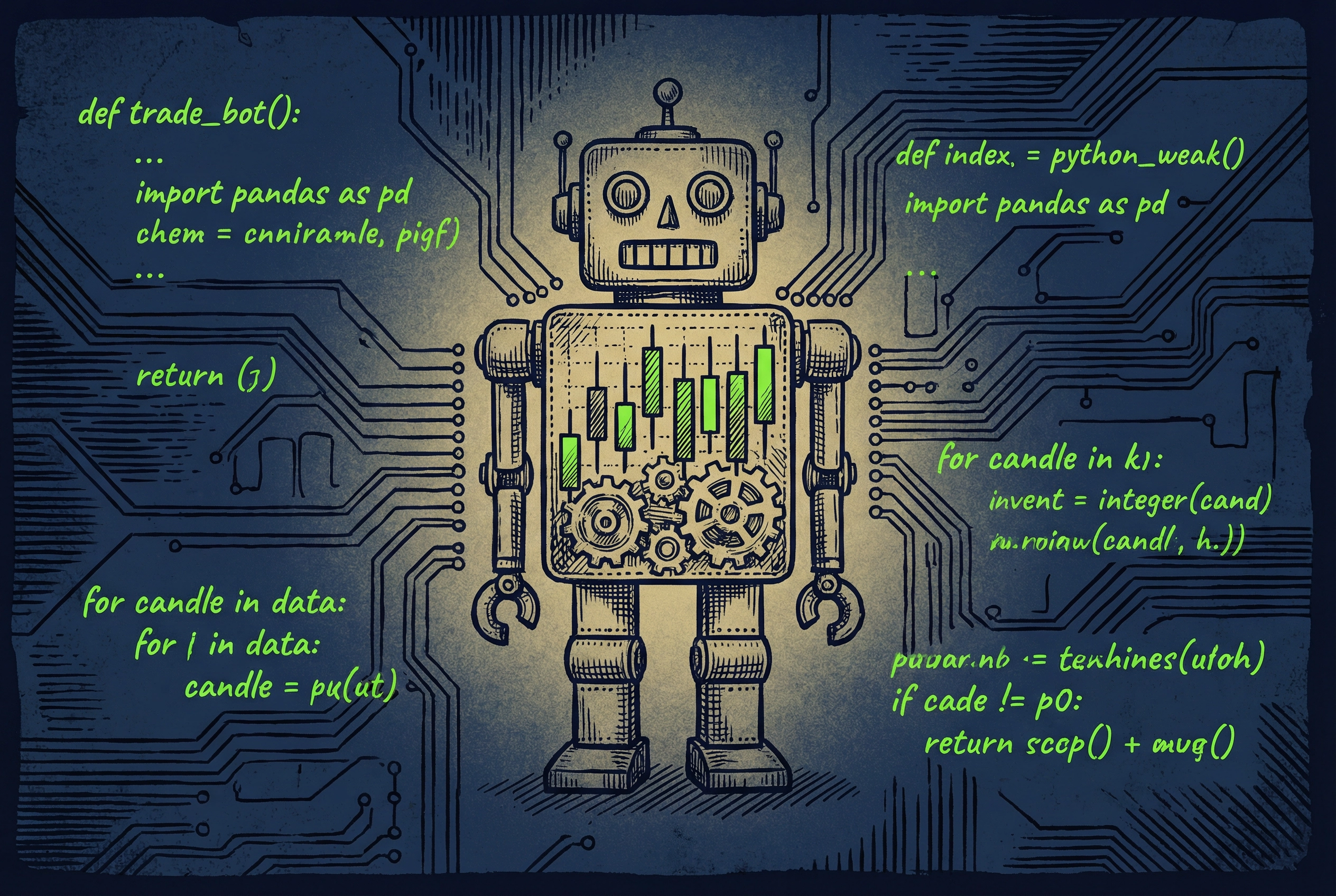
Building Your First Trading Bot
The gap between "I have a trading idea" and "I have a live, running system" is where most aspiring quants get stuck. This post walks through the practical architecture of a Python-based trading bot — not the theory, but the actual engineering decisions you'll face.
The Minimal Viable Architecture
A production-ready trading bot requires at minimum five components working in concert:
Data Feed → Signal Engine → Risk Manager → Order Manager → Broker API
                ↑                                              ↓
           Historical DB ←←←←←←←← Trade Logger ←←←←←←←←←←←←
Each arrow represents a data contract. Define these interfaces before writing any logic.
Data Feed: Your Foundation
Everything downstream depends on data quality. For equities, Interactive Brokers provides a solid API. For crypto, Binance and Coinbase have well-documented REST and WebSocket APIs. For backtesting, Yahoo Finance (via yfinance) is acceptable for daily data; for intraday, you'll need a paid provider like Polygon.io or Alpaca.
The most common beginner mistake: mixing adjusted and unadjusted prices. Always use split-and-dividend-adjusted closing prices for signal calculation. Use unadjusted prices only for execution.
Signal Engine: Keep It Stateless
Your signal engine should be a pure function: given a window of market data, return a signal. No side effects, no global state. This makes it trivially testable and composable.
1def compute_signal(prices: pd.Series, fast: int = 20, slow: int = 50) -> float:
2    """Returns +1 (long), -1 (short), or 0 (flat)."""
3    fast_ma = prices.rolling(fast).mean().iloc[-1]
4    slow_ma = prices.rolling(slow).mean().iloc[-1]
5    if fast_ma > slow_ma * 1.002:
6        return 1.0
7    elif fast_ma < slow_ma * 0.998:
8        return -1.0
9    return 0.0
Risk Manager: The Governor
Before any order reaches the broker, it passes through the risk manager. This component enforces:
- ▸Position limits: maximum notional exposure per instrument
- ▸Portfolio limits: maximum total gross exposure
- ▸Drawdown circuit breakers: halt trading if daily P&L exceeds a threshold
- ▸Correlation checks: prevent doubling up on correlated positions
The Mistake Everyone Makes
They backtest on close prices and execute on open prices — or worse, they don't account for the fact that you can't trade on the same bar that generated the signal. Always introduce a one-bar lag between signal generation and execution in your backtest. It's a small change that can dramatically alter your results.
Applied Ideas
The frameworks discussed above translate directly into deployable trading logic. Here are concrete next steps for practitioners:
- ▸Backtest first: Validate any signal-generation or risk-management approach with walk-forward analysis before committing capital.
- ▸Start small: Deploy with fractional position sizing and paper-trade for at least one full market cycle.
- ▸Monitor regime shifts: Set automated alerts for when your model detects a regime change — manual review before large rebalances is prudent.
- ▸Iterate on KPIs: Track Sharpe, Sortino, max drawdown, and win rate weekly. If any metric degrades beyond your predefined threshold, pause and re-evaluate.
- ▸Combine signals: The strongest edges come from combining uncorrelated signals — pair the ideas in this post with your existing alpha sources.
Sources & Research
4 articles that informed this post


From Theory to Practice
The concepts discussed in this article are exactly what we build into our products at QuantArtisan.
Found this useful? Share it with your network.